








TOUCHED BY LYME: (book review) "How to be sick"
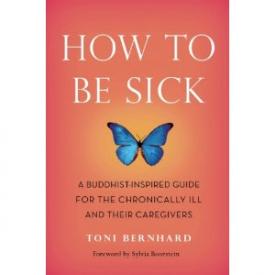
This book is not about how to get sick or how to stay sick. It's about how to "be" when you are sick. How to have a worthwhile existence, finding meaning, purpose and joy, even when chronic illness seems to have stolen your life away.
.
.
.
.
.
.
.
.
.
.
Reviewed by Dorothy Kupcha Leland:
How do you respond to the book title How to be sick? I’m guessing many folks with chronic Lyme disease would think something like this: “Geez, I’ve already got the ‘being sick’ part figured out. How about something on getting well?”
However, Toni Bernhard’s book entitled How to be sick: A Buddhist-inspired guide for the chronically ill and their caregivers (Wisdom Publications, 2010) is not about how to get sick, or how to stay sick. It’s about how to “be” when you are sick. How to have a worthwhile existence, finding meaning, purpose and joy, even when chronic illness seems to have stolen your life away.
It’s a tall order. And one that many chronically ill people (and their caregivers) may feel too overwhelmed even to contemplate. Yet, Bernhard found that certain ways of being helped her through the dark tunnel. In effect, dealing with chronic illness became her spiritual practice, and she has valuable insights to offer others in the same condition.
Some background: A long-time student of Buddhist meditation, Bernhard had a happy home life and a satisfying career as a UC Davis law school professor. Then, in 2001, she and her husband flew to Paris for what was supposed to be a romantic vacation. She fell ill on the trip with mysterious, debilitating symptoms from which she has never recovered. To this day, she spends many of her hours house-bound, often bed-bound, with what has been diagnosed as Chronic Fatigue Syndrome.
As her job, her friends, and her place in the community all fell away, Bernhard felt increasingly bereft and isolated on top of being sick, and turned to her Buddhist practices to help her deal with it all. By appreciating the gifts of the present moment, developing compassion for herself and her new limitations, and aiming for the Buddhist ideal of “the Middle Way,” she found she could achieve equanimity.
She writes: “The key to wise action for the chronically ill, then, is to avoid extremes. If we veer too far to the one side and act as if we have the stamina and physical abilities we used to have, we risk overexertion that could land us in bed for days. But if we veer too far to the other side of the road (for example, lie in bed in a fetal position, as I did for several months early on in my illness), we risk falling into despair.”
Not falling into despair is an important theme in Bernhard’s story and she walks readers through her own process for accomplishing that. Some chapter titles include: “With our thoughts we make our world,” “Getting off the wheel of suffering,” and “The struggle to find community in isolation.” (Hint: the internet helps a lot with that last one.)
How to be Sick is a touching memoir of Bernhard’s personal spiritual journey through her illness and how she ultimately found solace and coping skills through her Buddhist practices. It’s kind of a love story, as well, painting a tender portrait of the ways her husband (also named Tony Bernhard) has steadfastly supported her through this ordeal. She dedicates the book to him.
*****
Extra note from reviewer to author: Toni, many people with symptoms like yours turn out to have Lyme disease, and subsequently improve after appropriate treatment. From your book, I know you’ve spent time in places that are highly endemic for Lyme and co-infections. It doesn’t sound like you’ve been evaluated by a Lyme-literate doctor—one with the knowledge and experience to recognize the complexities of tick-borne illness. (Sad truth: mainstream medicine can’t help you here.) You are a two-hour drive from some of the top Lyme specialists in the country. In my opinion, it would be well worth your while to get checked out by one of them.
You can contact this blogger at dleland@lymedisease.org.
.




Very interesting …chronic Lyme has led me to explore the nature of suffering which in turn has spurned my growing interest in Buddhism over the last several years.
I plan to check this book out – thanks 🙂
I agree about being evaluated by a LLMD. She might have had it and if she had vaccinations prior to her trip to France, that would have brought it out full blown. Hep B vaccine almost killed me (I didn't know I had Lyme when I got it and then the booster like an idiot.)
I had a similiar experience to Jennifer. I took both Hep B and Yellow Fever immunizations before a trip to South America. I crashed and then recovered before a bigger crash and my diagnosis of Lyme.
Thank you for your review of this book. I often counsel people with chronic illness, and sometimes their caretakers, in how to live with mindfulness. Could you post your review on Amazon so that more people will see it, and understand what a valuable resource it could be for them?
I'm still feeling angry. There isn't a need in 2010 for anyone to have Lyme disease and have it go chronic. The medical community must stop the IDSA/CDC nonsense and get down to business and get this disease treated. Enough already.
Interesting comments by Jennifer and Mary re the impact of vaccinations. Now want to know if Tony got vaccinated before going! Also, vaccinations could be an important topic to be aware of if they can bring on Lyme symptoms.
Ok, to be fair to Paris and France, they have infected ticks aussi…
Back to the subject, yes to everything Dorothy writes about re the messages of this book. If we don't heed our limitations, we find out fast. I learned these lessons by default, not because I wanted to, but because I had no choice. I see the able-bodied world go whizzing around me all the time, 78with no idea of a slower pace option. I also lived with a couple folks with chronic fatigue and they knew these lessons well. One went into patiently handcrafting beautiful items for the home.
After going through the stages of grief because I lost my health, career as a special ed. teacher, community volunteer, busy wife and mom to sports and music-involved sons and husband, to Lyme (at first diagnosed as "fibromyalgia," with CFS)I finally turned seriously to my Christian faith. I began daily Bible study, meditation, incorporating yoga in my worship and doing even the least bit of volunteering again whenever the opportunity arose, I found peace and joy that I did not have when I pushed myself from 6:00a.m.-midnight 6 days a week. I now thank God for the time I've had to get to know Him and learn to love myself and others in a deeper way. After picking myself up from the initial shock of losing what I thought was everything, I found myself through God's eyes. What a blessing this illness has been!
I absolutely LOVE this book! The methods Toni teaches have completely changed my own experience of being bed/house bound from chronic Lyme. I have been able to find contentment in my life, regardless of how I feel in the day to day. The techniques take practice, and in the beginning they felt quite fake. However, with practice, they became truth for me. For example, when we are bedbound, and our family gets to continue to go live their lives and go to parties, weddings, baby showers, concerts, etc, it is so easy to become jealous and depressed that you are not able to go with them. Toni teaches methods of overcoming that, and with practice, I was able to find joy, true happiness, in watching my loved ones get to have those experiences. The jealousy, while completely understandable, was causing me suffering, and when the jealousy lifted, I was left with joy. I recommend this book to anyone I meet who is living with chronic illness or chronic pain. It was a total game changer for me. Thank you for the review!